

Why Maxing Your 401(k) Can Hurt Your Other Goals: A Family Case Study
Many families are very concerned about retirement - and they should be. Maxing the 401(k) feels like the responsible move: protect the future first, figure out everything else later. And often that instinct is right.
But it can also quietly leave you missing out on other aspects of life that matter now - a home you can actually buy, college you can actually fund, years that will not come back. This case study follows a family that put so much into retirement that those nearer goals barely had a chance. Retirement looked locked in. Buying a home and paying for college each sat near a coin flip. It also shows why "never leave the employer match on the table" is not as simple as it sounds once every goal shares the same paycheck.
Key takeaways
- Maxing a 401(k) can leave a home purchase and college underfunded when every goal draws from the same paycheck - even if retirement itself looks secure.
- The right contribution level is not a badge of discipline. It depends on how near-term goals compete with retirement for cash.
- A better plan often changes the mix over time: more toward college (and less into retirement) while nearer goals still need room, then enough back into the 401(k) later to collect the full employer match.
- "Never leave the match on the table" is not always the right rule for every year. Pausing unmatched (or even matched) contributions for a stretch can be right when nearer goals need the cash more.
Who this is for: households juggling a home purchase, college, and retirement on the same income - especially if retirement already looks fine while nearer goals do not. Who it isn't for: anyone whose retirement is still underfunded, or who is deciding whether to capture an employer match in isolation with no competing goals.
A responsible, disciplined family maxing out their 401(k)
In this illustrative TheLongPlan model run, a New York family earning about $200,000 a year has about $165,000 saved across cash, taxable investments, retirement accounts, and a 529. Like a lot of households, they are very focused on not falling short in retirement. They contribute $20,000 per year to pre-tax retirement accounts - enough to capture a $6,000 employer match - and only $3,000 per year to the 529.
Three goals draw from the same income:
- Buy a $1.1 million home in four years
- Fund private college for two children - with some FAFSA and institutional aid that TheLongPlan estimated into the plan, but not enough to close the gap on its own
- Retire at age 61
On paper, that looks disciplined. In practice, most of the savings effort is flowing into the goal that is farthest away - and the years that shape their life sooner are getting less of the plan. Aid helps with private college, but it does not erase the competition with the home purchase when retirement is still claiming most of the paycheck.
Retirement — secure; family home and kids' education — not so much
Retirement was not just fine - it was overfunded. Home and college were each a coin flip. The family was not failing to save. They were so concerned about retirement that the nearer goals never got a fair share of the paycheck. Extra dollars into an already-certain retirement plan barely moved retirement at all, while the chance of buying the home and funding college stayed stuck in the middle.
A better approach
TheLongPlan optimized the contributions by looking at all three goals together - the home, college, and retirement - instead of treating the 401(k) as a standalone target. That is the difference: every dollar is judged by what it does for the whole plan, not by how "responsible" the retirement line looks in isolation.
The optimizer does not pick one contribution level forever. The mix changes over time as goals clear: more to the 529 while the home and college are still competing for cash, then room to put more back into retirement once those nearer pressures ease. It also supported a more growth-oriented profile for the shared assets once college needed less from that pool.
Here is the original mix versus what TheLongPlan recommends over time:
| Plan | When | Pre-tax 401(k) | 529 | Employer match |
|---|---|---|---|---|
| Original | Every year | $20,000 | $3,000 | $6,000 |
| TheLongPlan recommended | Now (until the home) | $0 | $26,700 | $0 |
| After buying a new home | $8,400 | $27,700 | $4,200 | |
| After funding college | $12,000 | $0 | $6,000 |
The original plan keeps the same contributions every year. TheLongPlan changes the mix over time: right now, retirement contributions drop to zero so the 529 can rise; after the home is bought, some 401(k) comes back while college is still being funded; after college, it puts enough into the 401(k) to collect the full employer match.
| Illustrative TheLongPlan model run: goal outlook | Before | → | After |
|---|---|---|---|
| Home purchase | 50% | 84% | |
| College funding | 49% | 86% | |
| Retirement at 61 | 99% | 95% |
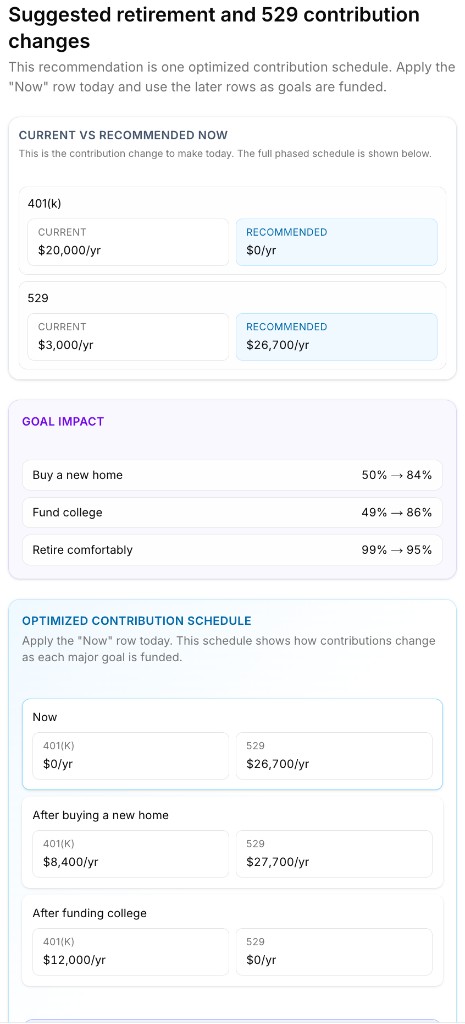
Home and college jumped into the mid-80s. Retirement fell only a few points - still very strong. The family kept a secure retirement path without giving up the home and college years that sit in the middle of life.
The house did not improve because dollars moved into a down-payment bucket. It improved because a larger 529 reduced the fight between house and college for the same shared cash - so both near-term goals could clear together.
The paradox explained
Why keeping the employer match made college much worse? Look at the "Now" row in that schedule: $0 into the 401(k) and $26,700 into the 529. That stretch also walks away from the employer match - about $6,000 a year of free money. If you are already anxious about retirement, that feels almost reckless. Conventional advice says never do that.
So we tested the obvious fix on that same early stretch, keeping the investment mix unchanged so only the contribution split moved: take $12,000 out of the 529, put it into the 401(k) - just enough to unlock the full match - and leave $14,700 a year for college.
| Illustrative sensitivity: if we reclaim the match on the Now row | Recommended | → | Keep match |
|---|---|---|---|
| Pre-tax retirement | $0 | $12,000 | |
| 529 college savings | $26,700 | $14,700 | |
| Employer match | $0 | $6,000 | |
| Home purchase | 84% | 92% | |
| College funding | 86% | 12% | |
| Retirement at 61 | 95% | 98% |
With the same portfolio, retirement does what you would expect: it rises, from about 95% to 98%, because the household is collecting the match again. College collapses - from the mid-80s to about 12% - because $12,000 a year left the 529.
The home score rising is the part that looks backward at first. It is not because the match somehow funds a down payment. It is because a traditional 401(k) contribution and a 529 contribution do not cost the same in take-home pay. Money into a 529 comes out of after-tax cash dollar for dollar. Money into a traditional 401(k) is pretax, so each dollar deferred reduces take-home pay by less than a dollar. Moving $12,000 from the 529 into the 401(k) therefore left a few thousand dollars a year more in the checking-and-brokerage pool the home purchase draws from - even while college lost the full $12,000.
So the match really is free money, and reclaiming it does help retirement. But in this plan it helps retirement (and slightly the home) by pulling support away from college. The hard question is not "is free money good?" It is which part of life is short on cash right now - and here, pulling money back into the 401(k) made college fail.
Can you save too much in a 401(k)?
Relative to the rest of the plan, yes - especially when a home purchase and college are competing with retirement for the same paycheck. If retirement already feels secure, the next dollar may matter more in a 529 than in another year of 401(k) contributions - even matched ones. Being very concerned about retirement is healthy. Letting that concern crowd out a home, college, and the years in between is how a family can look "responsible" on paper and still miss out on the life they were trying to protect.
FAQ
Can you save too much in a 401(k)?
Relative to the rest of the plan, yes. If you are already on track for retirement while a home purchase and college are still far from secure, the next dollar may matter more in a 529 than in another year of 401(k) contributions — even matched ones. Protecting retirement at the expense of the life you are trying to build is not always the responsible choice.
Is it ever okay to leave an employer 401(k) match on the table?
Usually no as a forever rule — but sometimes yes for a defined stretch. In this case study, pausing pre-tax 401(k) contributions early freed cash for the 529 while home and college still needed room. Reclaiming the match in those same years kept retirement slightly higher but left college nearly out of reach. TheLongPlan recommendation later returns enough to the 401(k) to collect the full match once those nearer pressures ease.
What does a feasibility score mean?
It is the percentage of simulated market and income scenarios in which a given goal is fully funded on its target timeline. A retirement score near 100% means the goal succeeds in essentially every simulated future under current assumptions; about 50% means it succeeds in roughly half of them. It is a probability, not a straight-line projection.
Why did the home purchase score improve when more money went to the 529?
No money moved directly from the 401(k) into a down-payment account. A larger 529 reduced how much college needed from the shared cash pool, so house and college competed less. Both near-term goals could clear together.
How do I know if my own retirement contribution is too high?
Look for a large gap between goals, not a specific dollar amount. If retirement already feels locked in while other goals on the same timeline still feel uncertain — buying a home, funding college, living the years in between — the current split may be crowding those out. The right level depends on age, income, other assets, and every goal drawing from the same paycheck — visible only when they are modeled together.
For the broad explainer on why goals look different together than they do apart, read Why Saving for Retirement, College, and a House Separately Fails For how aid estimates change the college target, see FAFSA and Financial Planning Are Different Tasks — But They Use the Same Information. For a different version of the same pressure, where the home target itself is the problem, see When Your Home Target Crowds Out College.